

Call Us At
Call Us At

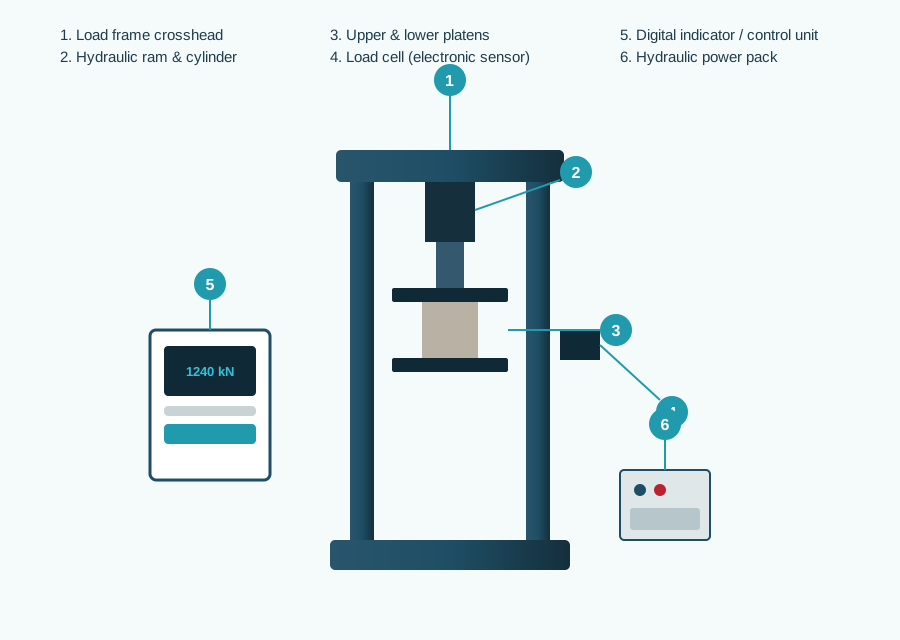
Choosing a concrete compression testing machine is one of the most consequential equipment decisions a civil engineering lab in Africa will make: it is used daily, it underpins every concrete strength certificate the lab issues, and a wrong specification can mean the machine is unsafe to use at full design strength or under-utilised for years. This guide walks through the decisions step by step, and links to the full Concrete Compression Machine Africa range supplied by Trio Africa for detailed specifications.
Compression machine capacity is rated in kilonewtons (kN). To avoid both under- and over-specifying:
| Type | How it works | Best for |
|---|---|---|
| Analogue | Dial gauge, manual reading of peak load | Low-cost routine testing, training labs |
| Digital | Electronic load cell with digital display | Accurate readings, reduced parallax error |
| Automatic | Controlled loading rate, auto peak-hold, data logging/printing | Accredited labs (ISO/IEC 17025), high test volumes |
As more African national standards bodies and consultants require ISO/IEC 17025 accreditation, automatic or digital machines with a printed or exportable test record are becoming the safer long-term investment, even where the upfront cost is higher than an analogue frame.
Loading rate, platen flatness tolerance and specimen size limits differ between standards. Confirm with your client or consultant which standard applies before ordering:
Make sure the platen dimensions and the maximum vertical clearance ("daylight") between platens match your largest specimen – both for cubes (150 mm or 200 mm side) and cylinders (150×300 mm or 250×500 mm). A machine that is otherwise the right capacity but has insufficient daylight cannot test your full range of specimens.
A compression machine needs periodic calibration of its load cell/load measuring system and inspection of its platens to remain accredited. Before you buy, confirm:
Trio Africa provides calibration, restoration and digital-controller upgrade services for existing load frames in addition to supplying new machines – see our calibration and technical support services for details.
The full range of 1300–5000 kN analogue, digital, automatic and servo-controlled concrete compression machines supplied across Africa – including capacity, control type and typical use for each model – is compared on our Concrete Compression Machine Africa page.
Send us your specimen sizes, expected concrete strength and testing standard and we will recommend the right capacity and control type.
Talk to Our TeamRelated reading: Compression Machines, Compressive Test Guide, Concrete Testing Equipment.


 CONTACT
