

Call Us At
Call Us At

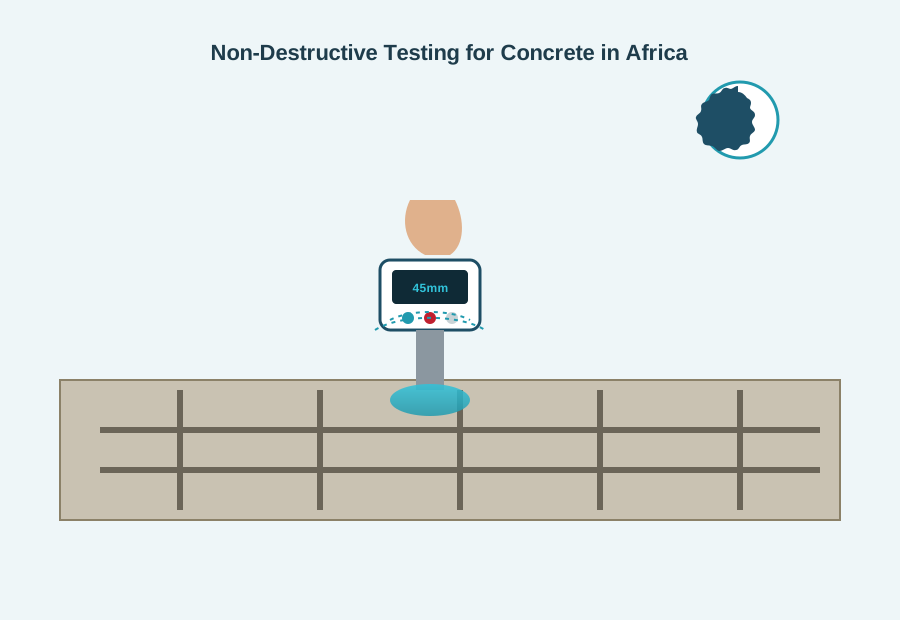
As Africa's building stock ages and infrastructure investment accelerates, engineers increasingly need to assess existing concrete structures – bridges, buildings, parking structures – without damaging them. Non-destructive testing (NDT) equipment makes this possible, revealing what is happening inside concrete without coring or demolition.
| What You Need to Know | Equipment |
|---|---|
| Locate rebar position & cover depth before coring or drilling | Rebar locator / bar size determination system |
| Map corrosion risk across a structure | Half-cell potential system (COR-MAP II) |
| Measure active corrosion rate | GECOR 8 corrosion rate determination system |
| Detect voids, cracks & assess material properties | Ultrasonic pulse velocity system (V-METER MK IV) |
| Check chloride ingress | Chlorimeter chloride field test system |
| Verify pile integrity below grade | Low strain pile integrity tester / cross hole sonic logging analyzer |
| Monitor crack movement over time | Avongard Tell-Tale crack gauges |
Full specifications are available on our James Instruments NDT Equipment Africa, Avongard Crack Monitoring Equipment Africa and Non-Destructive Testing (NDT) Equipment Africa pages.
Coastal cities and industrial zones across Africa see accelerated reinforcement corrosion from chloride exposure and carbonation. Half-cell potential mapping and corrosion rate meters let asset owners prioritise repairs on a structure long before cracking or spalling becomes visible, turning an unplanned failure into a planned maintenance budget line.
NDT methods are ideal for screening large areas quickly and repeatedly without damaging the structure, but they are typically calibrated against a smaller number of destructive reference tests (e.g. core samples tested on a concrete compression machine). A sound assessment programme in Africa usually combines both: NDT survey first to identify problem areas, then targeted coring and lab testing to confirm.
Tell us what you need to evaluate – corrosion, voids, cracking or pile integrity – and we will recommend the right NDT instrument.
Request a Quote

 CONTACT
